

How to Build an AI Chatbot for Your Website
AI models such as ChatGPT have significantly raised the bar for chatbots. As a result, companies are now increasingly interested in building effective AI chatbots that can support customers in real time, generate leads, and noticeably reduce the workload of service teams.
Allowing artificial intelligence to independently assist customers and relieve employees not only cuts service costs by more than 50 percent, but also has a positive impact on customer satisfaction.
Many companies rely on chatbot providers to automate customer inquiries on websites and messaging channels such as WhatsApp or Instagram. With Lime Connect, you can create an AI chatbot in just a few minutes, seamlessly integrate it into your website, and deploy it instantly across all channels.
In this article, you’ll learn step by step how to set up an AI chatbot, what benefits it offers, and how AI Agents from Lime Connect can take your customer service to the next level.
- What is a website chatbot?
- Website chatbot vs. AI agent: what’s the difference?
- Why is an AI chatbot an essential tool for your website
- How to build a chatbot for your website
- What is a good chatbot software?
- Examples of AI website chatbots
- Connect AI – The platform for AI-powered customer communication
What is a website chatbot?
A website chatbot is a conversational program that can be integrated into any website in just a few steps. Website visitors can interact with the chatbot around the clock—for example, to ask questions, solve problems, or get assistance during the purchasing process.
In addition, the chatbot can proactively engage users, for example by offering support, informing them about promotions, or sending coupons.
The same chatbot you create for your website can also be used across messaging apps such as WhatsApp and similar channels—and vice versa.
Website chatbot vs. AI Agent
In the past, chatbots had to follow static question-and-answer flows (if x, then y). As a result, they often ended up in “verbal dead ends.” Today, things look very different. Advanced chatbot providers now work with AI systems and integrate OpenAI’s GPT‑4 to deliver a positive and natural bot experience for customers.
AI chatbots are based on technologies such as Natural Language Processing (NLP) and Natural Language Understanding (NLU). This enables them to understand the intent and context behind a question and to imitate human language patterns. When a visitor asks a question, the chatbot analyzes the user’s intent and searches the connected knowledge base for the most relevant answer. The result is authentic dialogues that mirror human conversation while delivering solution-oriented responses in seconds.
Modern providers like Lime Connect, go beyond traditional chatbots and rely on agentic AI.
AI agents don’t just answer questions; they independently execute actions, such as creating tickets, retrieving order information, or updating customer data. They understand more complex relationships, make decisions, and autonomously handle entire processes.
This transforms the website chatbot into an active, digital service agent that manages both conversations and operational tasks.
From a business perspective, this means: while a traditional chatbot reacts based on predefined questions, an AI agent acts proactively. It interprets data, makes autonomous decisions, and optimizes customer processes in real time. What emerges is more than automation—it’s true digital assistance, a key differentiator that strategically elevates the use of AI on your website to the next level.
Why is an AI chatbot an essential tool for your website?
Not entirely sure whether “hiring” a chatbot is worth it? According to recent market analyses, around 25% of all companies will use chatbots as their primary customer service channel by 2027. The following benefits of AI-powered chatbots and AI agents may help you make your decision:
For businesses
- Boosts customer engagement: Similar to in-store sales assistants, proactive chatbots can engage customers while they browse your online shop. When your website chatbot appears at the right time and in the right place, it increases the chances of positively influencing the buyer journey.
- Automates tasks: Chatbots free your service teams from repetitive tasks. Lime Connect’s AI agents take this a step further by managing entire processes, analyzing data, and executing actions autonomously.
- Cuts down service costs: Chatbots can’t replace human employees—but they can reduce service costs by up to 30%. They respond quickly to customer inquiries and give your teams more time to focus on complex, value-added tasks.
- Pairs well with live chat: Most AI website chatbots can be connected to your live chat software, making it easy to hand over unresolved questions from the bot to a service agent. Agents can also monitor the chatbot’s performance and chats transcripts in the live chat dashboard.
- Available 24/7: Chatbots provide instant, real-time support that isn’t tied to business hours. If your customers are mainly active outside your service times, website chatbots help answer questions and recommend product pages, blog posts, and tutorials.
- Gives your company a voice: When personal interaction isn’t possible, chatbots help shape how customers perceive your company. You have full creative control over the tone, appearance, and language style of your AI chatbot—ideally aligned with your brand identity.
- Easy to maintain: AI agents fundamentally differ from traditional chatbots. Instead of relying on fixed rules or static FAQ lists, they access your knowledge flexibly and adapt responses dynamically—significantly reducing maintenance effort.
For customers
- Quick responses: Chatbots respond almost instantly, so customers don’t have to wait in queues just to resolve a simple question.
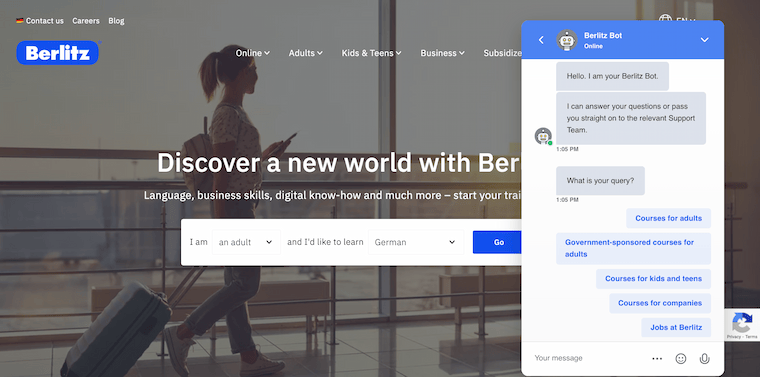
- Easily accessible: An AI agent can be embedded on any page of a website or in a messenger, making it easy for customers to reach help when they get stuck. There are no waiting lines, and the bot reduces the steps customers usually have to take to reach a human agent.
- 24/7 availability: This benefit applies to both sides. For night owls or shoppers with tight schedules, website chatbots become portable digital assistants. Customers can start a conversation at any time and reply whenever it suits them.
- Relaxed conversation: Many customers find it easier to talk to a chatbot than to a service agent, as there’s no pressure to maintain formal conversation etiquette. Customers can skip pleasantries and ask their questions directly, shortening the interaction.
- Direct and personal: Chatbots proactively engage customers at the right moment—for example, when a website visitor spends more than 10 seconds on a product page or in the shopping cart. They provide personalized recommendations and use personal greetings if the customer’s name is known.
How to build an AI chatbot for your website
Now you’ve learned how both your company and your customers can benefit from website chatbots. In this section, we’ll show you how to create a powerful AI chatbot for your website in five simple steps.
- Define your chatbot’s purpose
- Choose an AI chatbot platform
- Design your conversation flow
- Test and refine your AI chatbot
- Launch your AI chatbot
Define your chatbot’s purpose
Before choosing a chatbot software, you should clearly define what your AI chatbot will be used for.
For example, think about which target audience you want to address, which problems your chatbot should solve, and which channels it should be deployed on (only the website, or also messengers and apps such as WhatsApp and Instagram, etc.).
An AI chatbot is a member of your team, not a nice-to-have accessory. That’s why defining its role is essential for both the design and the dialogue structure.
Choose an AI chatbot platform
There are many platforms and programming languages you can use to build a chatbot, such as Dialogflow, BotSociety, or IBM Watson. However, we recommend providers that combine AI, automation, and human support in a single platform—such as Lime Connect (formerly Userlike) with Connect AI.
With our AI suite, you can create autonomous AI agents in just a few steps. These agents act as digital service employees who handle customer inquiries independently—from simple questions to complex processes. In the central Message Center, your team can monitor, manage, and seamlessly take over all bot conversations across all channels (website chat, WhatsApp, and more) whenever human intervention is needed.

The AI accesses a central knowledge base that you maintain with company information via website sync, file upload, or manual input. All Connect AI modules use this shared data, ensuring a consistent and professional customer experience at all times.
Build a knowledge base
A solid knowledge base is the heart of a powerful AI-driven customer service. The more comprehensive and well-structured it is, the better your chatbot can understand context, deliver accurate answers, and handle even complex inquiries.
With Lime Connect (formerly Userlike), you can centrally collect all relevant company information—from FAQs and help articles to product details or internal processes.
In Connect AI, your knowledge base can be set up and maintained quickly. Content can be added via website sync, file upload, or manual entry, and all updates are automatically available to every AI module—ensuring an intelligent, consistent, and always up-to-date customer service experience.
Test your AI chatbot
Once your chatbot is ready, test it thoroughly—especially from the perspective of your target users. In a soft launch, you can allow only colleagues and selected customers to try the chatbot before rolling it out on your website or messenger channels.
Evaluate response quality, reaction times, and handovers to human agents. With the integrated monitoring in Connect AI, the performance of your AI agents can be easily analyzed. This allows you to continuously optimize workflows and ensure an excellent customer experience.
Launch your AI chatbot
After your AI chatbot has passed all tests, integrate it on the pages and channels where it provides the most value.
If you’re developing a chatbot for customer support, it makes sense to deploy it on your homepage and/or contact page, as well as in popular messaging channels like WhatsApp.
If your goal is to generate more leads and sales, it’s better to use the bot across your entire website. This way, it can proactively engage visitors before they leave your site or abandon their shopping cart.
What is a good chatbot software?
For chatbot beginners, almost every piece of software sounds promising. It’s no surprise, then, that many chatbot providers use buzzwords like AI and automation without explaining what technology is actually behind their website chatbot.
To find the right tool for your company, you should test it thoroughly and/or evaluate it based on specific features and capabilities before making a decision.
Our list of the most important criteria for a good chatbot solution can help:
- Chatbot type and technology. Does your bot work with fixed if-then rules, or does it use advanced AI? AI chatbots are now the standard, but AI agents—like those from Lime Connect—represent the next stage of development. They act autonomously, respond intelligently based on the latest LLM technology, and execute processes independently.
- Website chat. Choose a platform whose chat widget can be easily customized to match your web design and that supports multiple channels such as WhatsApp, Facebook, or Instagram. This ensures your chatbot works just as effectively on your website as it does at other touchpoints.
- Compatible apps. Can the bot be deployed across all the channels you want to use, such as WhatsApp, Facebook, or Instagram?
- Complexity and effort. Is setup and maintenance time-consuming? Is there a visual builder, or the ability to automatically add website content and documents to the knowledge base?
- Implementation and usability. Can you create the bot yourself in just a few steps, or do you need a developer’s help? Is the platform intuitive—for both customers and service agents?
- Bot-to-human handover. Does the chatbot software already include live chat, allowing you to hand over conversations to a human agent at any time, or do you need to integrate a separate chat tool?
- Integrations. Can the chatbot be connected to your existing software infrastructure, for example to pass customer information to your CRM system?
- Price and ROI. Is the chatbot platform worth the money considering the features it offers? Look for transparent pricing models and measurable results. Good providers can demonstrate return on investment—for example through reduced support costs or increased lead volume.
- Data protection. Is the chatbot tool GDPR-compliant?
Use cases for website chatbots
With our AI suite, Connect AI, companies across a wide range of industries are already successfully using AI agents. Thanks to their flexibility and the ability to adapt them to specific business needs and goals, these digital assistants are no longer limited to e-commerce—they are now also widely used in the finance and logistics sectors.
In practice, one thing is clear: a well-designed AI chatbot on your website can demonstrably reduce handling times, improve response quality, and increase customer satisfaction—while simultaneously lowering support costs.
Here is a selection of intelligent chatbots our customers have built with Lime Connect:
AI chatbot in the logistics industry: Hermes
The logistics and parcel service provider Hermes Germany also relies on AI chatbots. Their custom-built chatbot “Bo” supports customers with all questions related to shipment tracking, for example, rescheduling deliveries or checking when a parcel will arrive. If a customer wants to report a damaged package, Bo seamlessly hands the chat over to a customer service agent.
Hermes’ AI chatbot achieves a resolution rate of 65%, independently handling more than half of all incoming inquiries. Combined with an average customer satisfaction score of 4.2 out of 5 stars, Bo has proven to be a highly successful digital assistant.
AI chatbot in the finance industry: PSD Bank Nürnberg
While many financial institutions are still hesitant, PSD Bank Nürnberg eG is already embracing the potential of AI-powered support. To do so, the bank created the friendly bot B.A.N.K.S.I, which assists customers with their banking needs around the clock.

B.A.N.K.S.I is used both directly on the PSD Bank website and on WhatsApp. It handles 85–90% of customer inquiries and has even successfully facilitated the opening of checking accounts.
AI chatbot in the travel industry: TUI Austria
Travel provider TUI Austria relies on an intelligent AI bot in its customer service operations. “Sophie” supports travelers with trip planning and achieves an impressive resolution rate of 86%.
Due to the complex nature of the inquiries TUI’s customer service team receives every day, an AI agent is far better suited than a “standard” rule-based bot.

The bot’s knowledge comes from the core of Connect AI: the central knowledge base. This is connected to the company’s website via website sync and automatically pulls in all up-to-date information eliminating the need for manual data maintenance.
Best practices for building AI chatbots
These examples clearly demonstrate the potential of AI-powered communication. Whether you’re creating a new AI chatbot for your website or enhancing an existing service with AI, success depends on combining clearly defined use cases, a high-quality knowledge base, and a strong focus on user needs. This is how a simple bot becomes a true digital AI agent—one that delivers measurable results and moves your business forward.
Connect AI – The platform for AI-powered customer communication
With Connect AI, you experience a completely new dimension of customer communication: efficient, scalable, and still personal. Our solution is built on state-of-the-art generative AI and combines automation with human empathy.
AI Agents and an interactive service assistant handle customer inquiries reliably around the clock and automate recurring processes. This relieves your team, improves response times, and increases customer satisfaction without compromising on quality or personal support.
At the heart of the platform, three core components ensure seamless operations:
The Knowledge Base securely stores your company knowledge and delivers relevant answers in every customer interaction. Actions enable AI Agents to make independent decisions and dynamically execute workflows, API calls, or system actions. With Monitoring, you always maintain full visibility into AI activities and can make targeted optimizations at any time.

Built on these components, Connect AI offers two central modules:
AI Agents act as autonomous digital employees that independently handle inquiries, execute processes on their own, and integrate seamlessly into website chat, WhatsApp, email, as well as CRM and shop systems. They reduce your team’s workload by up to 70%, increase efficiency, and ensure consistent, high-quality customer support around the clock.
Copilot serves as an intelligent assistant for your service agents, providing real-time summaries, context-based reply suggestions, and easy access to information from your knowledge base.
Our AI solution works out of the box, requires no IT expertise, is GDPR-compliant, and is ideal for companies looking to make their customer communication efficient, intelligent, and future-proof.
Discover Connect AI and take your customer service to the next level with AI Agents. Try Lime Connect for free and see how intelligent automation makes your customer communication more efficient, faster, and more personal. We look forward to supporting you with your chatbot project!
About the Author

Leah Liebl
Leah is a copywriter and AI expert. She’s a proud Texan who spends her free time cuddling her dog, learning Japanese and rereading Harry Potter.
Related Articles
-
Read now: WhatsApp Automation: The Essential Guide for Businesses
 AI & Chatbots, WhatsApp marketing
WhatsApp Automation: The Essential Guide for Businesses
WhatsApp automation in business: definition, possible applications, and legal principles explained concisely.
-
Read now: Introducing Connect AI: A New Chapter for Customer Service
 AI & Chatbots, News & Updates
Introducing Connect AI: A New Chapter for Customer Service
Transform your customer service with Connect AI: autonomous AI Agents, intelligent Copilot support, and automated workflows for faster, smarter, 24/7…


Start your free trial
There’s no time to waste! Let’s find the solution that will help you get more customers and turn existing ones into loyal ambassadors today.